FactoryOS
Manufacturing ERP for Indian small factories: BOMs, purchase, production, stock and GST invoices.
Multi-level bills of materials with cost roll-up, purchase orders and goods receipts, work orders with material issue and good / rejected / scrap output, a shortage report that drafts your purchase orders, stock across stores, and GST tax invoices from delivery challans. It runs on your own server, so your costs and customers never leave it.
For Indian MSME manufacturers — engineering, fabrication, assembly and processing units — that plan production on spreadsheets today.
See it work · 2:30
No sound — the captions explain each step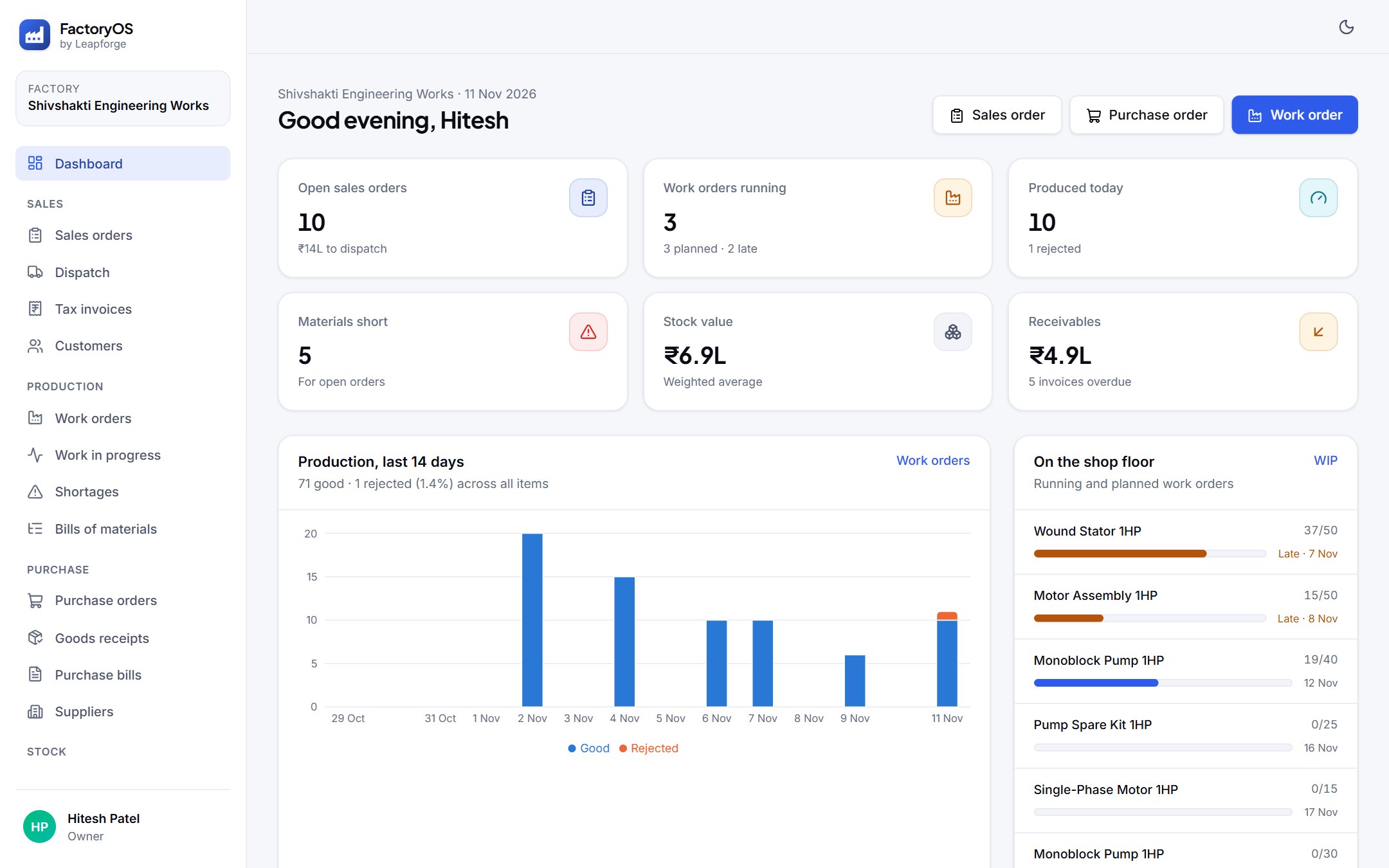
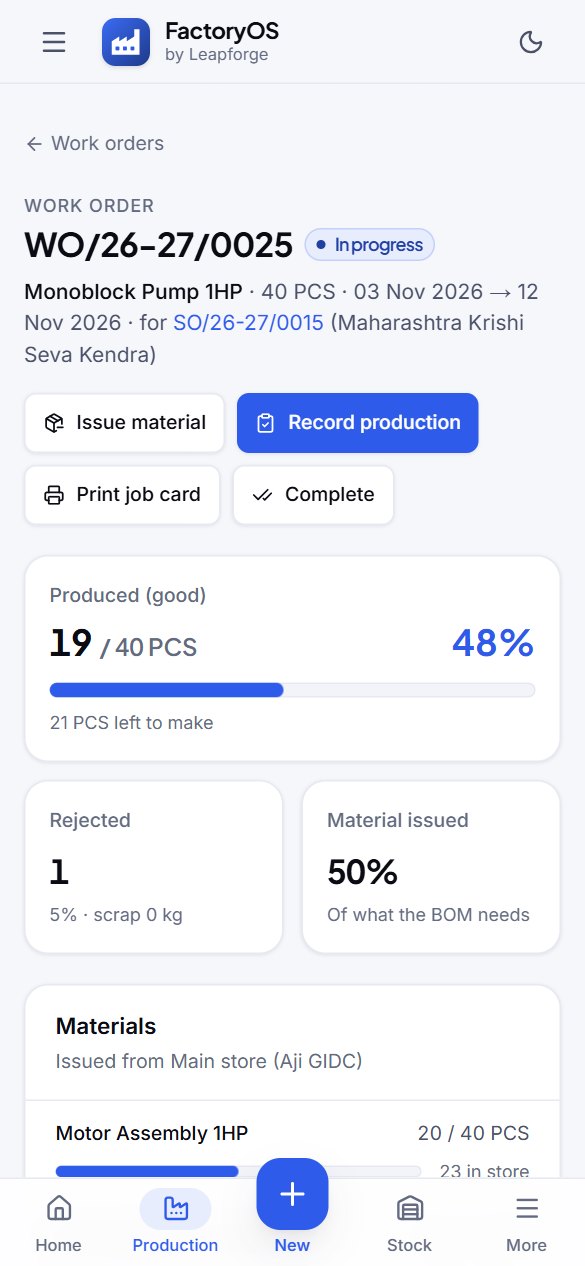
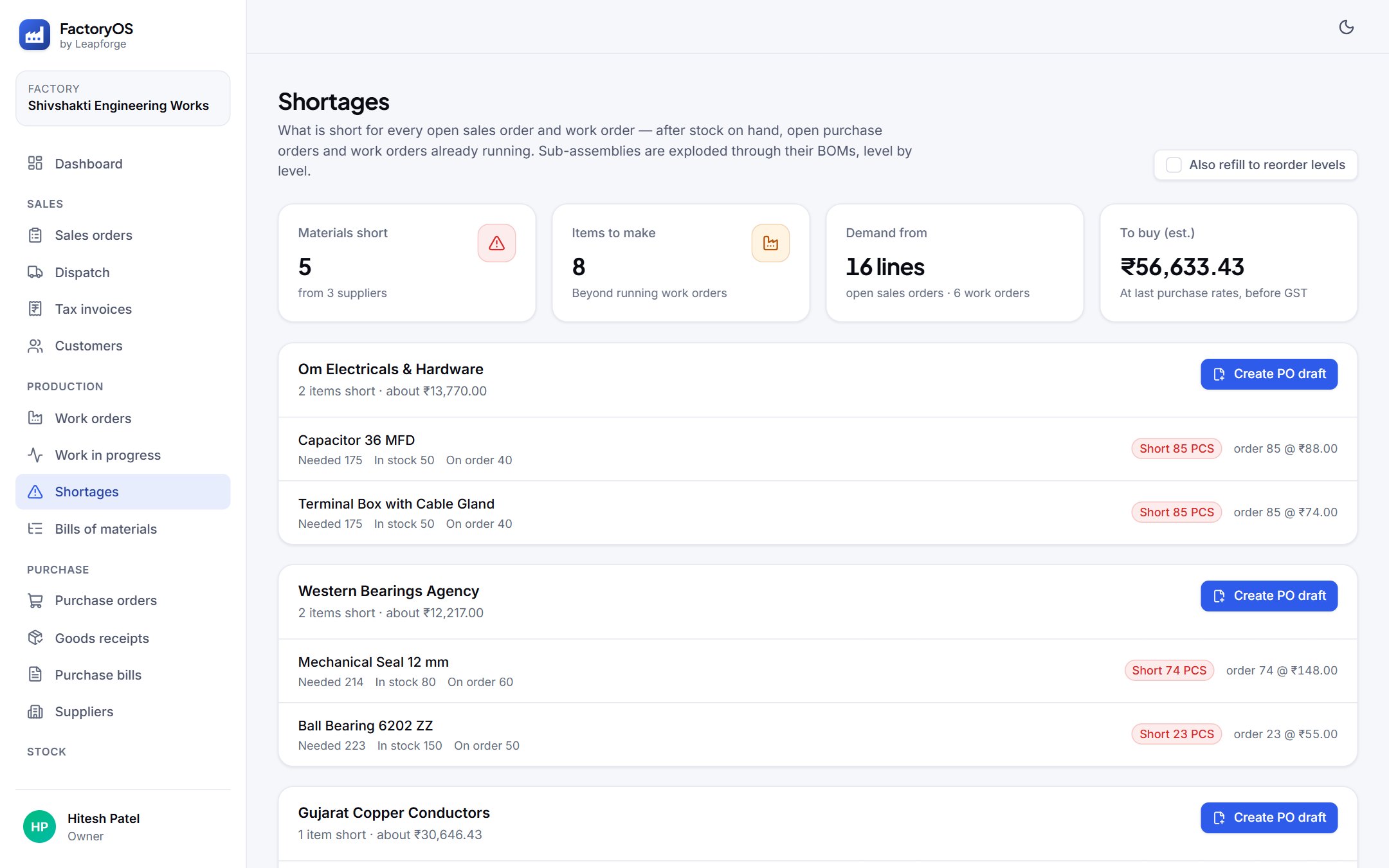
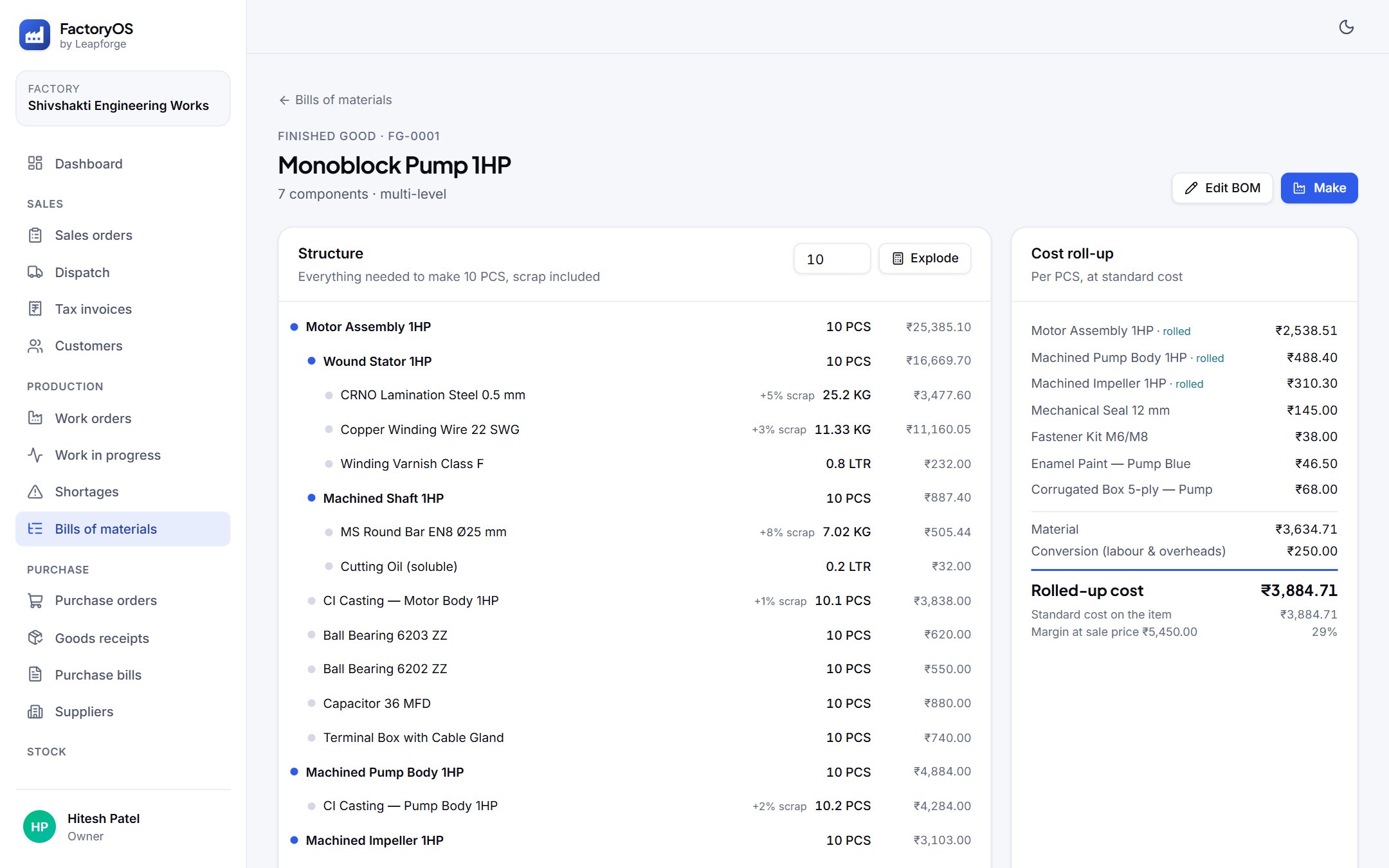
Captured from the demo company, with sample data, November 2026.
What it does
- Items
- Raw materials, semi-finished parts, finished goods and consumables, each with a stock unit and an alternate unit (buy bearings by the box, use them by the piece), HSN, GST rate, reorder level, standard cost and usual supplier.
- Bills of materials
- Components with quantity and scrap %, multi-level (a sub-assembly has its own BOM), loops refused before they are saved, a full explosion for any quantity, and a cost roll-up through every level that you can apply to the standard cost in one click.
- Purchase
- Purchase orders from draft to approved, goods receipts against the PO with accepted and rejected quantity and partial deliveries, the supplier's bill booked from the receipt, supplier payments, and a pending-PO report that flags late deliveries.
- Production
- Work orders for stock or straight from a sales order line, each with its own copy of the BOM; material requirement against store stock; material issue to the shop floor; production entries for good, rejected (with a reason) and scrap; progress, status and work-in-progress value; a printable job card.
- Planning
- One shortage report for every open sales order and work order: stock, open purchase orders and running work orders are netted, sub-assemblies are exploded level by level, and each supplier's shortages become a draft purchase order in one click. Optionally tops stock up to reorder levels.
- Stock
- Several stores and warehouses, transfers, adjustments that always carry a reason, a ledger for every item with running balance, weighted-average valuation and a low-stock list.
- Sales and GST
- Customers, sales orders, delivery challans with partial dispatch, and GST tax invoices made from challans: CGST and SGST or IGST from the place of supply, HSN summary, amount in words and a UPI QR code. Receipts, receivables ageing, and invoices and payment reminders sent on WhatsApp.
- Documents
- A4 purchase orders, goods receipt notes, job cards, delivery challans and tax invoices on your letterhead. Purchase orders and invoices have a private link your supplier or customer opens without signing in.
- Security
- Bank details encrypted with AES-256-GCM · passwords hashed with bcrypt · role checks on the server for every page and action · login lockout after repeated failures · security headers · an audit log of sign-ins, changes and exports · optional encrypted backups · 19 automated security tests.
- Team
- Seven roles: Owner, Admin, Purchase, Production, Stores, Sales and Accounts. Each sees only its own work, every action is checked again on the server, stores and sales staff never see costs, and an audit log records every change.
Tested: 39 automated tests on the BOM, planning, costing, stock and GST engine, the role rules and security, an end-to-end test that runs a purchase order through receipt, bill, work order, material issue, production, sales order, dispatch, invoice and payment, a browser check of every page signed in as all seven roles on desktop and phone, and 10 end-to-end security tests.
Questions buyers ask
+Can a part have its own bill of materials?
Yes. A semi-finished part such as a wound stator or a machined shaft has its own BOM, and the finished product's BOM uses it. Requirements, the shortage report and the cost roll-up all go through every level.
+How is stock valued?
At weighted-average cost. Goods received come in at the purchase-order rate; issues and dispatches go out at the average at that moment; finished goods come in at the actual cost of the material issued plus your conversion cost.
+Does it file my GST returns or make e-way bills?
No. It makes the GST tax invoice with the HSN summary and keeps a sales register you can download for your CA. Filing, e-way bills and e-invoicing stay with you.
+Can my storekeeper use it on a phone?
Yes. Every screen works on a phone: receiving goods, issuing material, booking production and dispatching. Stores staff see quantities, never costs.
+What happens after 12 months?
It keeps working, forever. The 12 months is for updates and support; renewing them is optional.
How buying works
Four steps, no call, nothing hidden.
- 01
Order at the listed price
Fill in the order form: the name the licence should carry, an email, and whether you want installation.
- 02
Pay by UPI or bank transfer
Within one working day we email the payment details and the exact amount. No call, no quote.
- 03
Get your licence and package
Within one working day of payment: the licence key, the Docker package and the installation guide, by email.
- 04
Run it on your own server
Install it yourself with the guide — it is a few Docker commands — or add our installation and we do it for you.
Before you pay
The terms, stated up front.
The price on the listing is the price
No quote, no call, no negotiation. What is included and what is not is written on the listing.
It runs on your own server
Your server, your domain, your data. It checks its licence offline and never phones home to us.
Changes are an ordinary build
The listing says whether source is included. If it needs to do something it does not do, we quote that separately — or tell you if buying was the wrong call.
7 days to change your mind
A full refund within 7 days of purchase if the licence key has not been activated. The full terms are on the refund policy page.
Full terms: refund policy.
FactoryOS · ₹34,999
One-time licence · one factory · unlimited users · 12 months of updates